
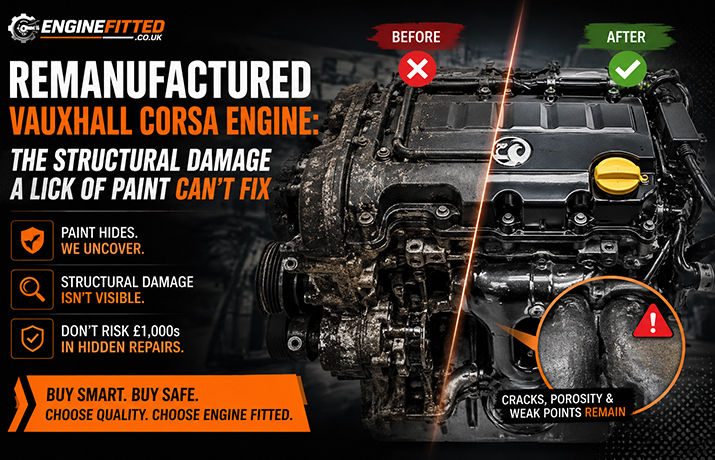
What is a remanufactured Vauxhall Corsa engine? A genuinely remanufactured Vauxhall Corsa 1.4 NEJ engine is one that has been stripped to bare block, cleaned to bare metal via hot-tank or aqua-blast, measured at every critical tolerance against Vauxhall OEM specifications, and rebuilt with new or reconditioned components to factory tolerances — then bench-tested before despatch. It is not a honed block with new rings. It is not a painted engine with a new head gasket. Remanufactured means every wear component is measured, every worn dimension is restored, and a post-build test sheet documents that the finished engine meets OEM performance parameters. Anything less is a repair with a marketing upgrade.
There is a word being used in the used engine market that means nothing. That word is “remanufactured.”
Under UK Trading Standards, there is no legal definition for “remanufactured,” “fully reconditioned,” or “rebuilt.” Suppliers know this. They use the language freely, precisely because it is legally unenforceable and technically unverifiable by the average buyer. A honed bore, a new head gasket, and a coat of reconditioned Vauxhall red engine paint cost a parts-changer roughly £180 in consumables and four hours in labour. It photographs identically to an engine that took twelve hours, a surface grinder, a CMM gauge, and £600 in new components to produce properly.
The difference between the two — structurally — is the difference between a structural repair and a cosmetic one. And the buyer, absent a test sheet and a tolerance record, cannot tell them apart.
The engine is fully stripped to bare block. Every component is segregated into three categories: replace as standard (bearing shells, piston rings, gaskets, seals, timing belt/chain components), inspect-and-measure (crankshaft, camshaft, block, head), and condemned on inspection (cracked components, worn beyond service limit).
The block and head are cleaned to bare metal using either hot-tank alkaline immersion or directed aqua-blast. This is non-negotiable: oil galleries, coolant passages, and combustion chamber deposits cannot be removed by solvent-spray alone. Once clean, the block and head are pressure-tested. For the Corsa 1.4 NEJ, the cooling system passages are tested at 1.2 bar for a minimum of 15 minutes; any pressure drop indicates a crack or porosity fault.
Bore diameter is measured with a dial bore gauge at six points per cylinder: top, middle, and bottom of the piston stroke, measured on both the thrust axis and the pin axis. For the Vauxhall 1.4 NEJ (Z14XEP/Z14XE family dimension), the standard bore diameter is 73.00 mm. OEM wear limit for taper within the bore is 0.05 mm; ovality limit is 0.05 mm. If any cylinder exceeds either limit, the block is re-bored to the next oversize (typically +0.25 mm, +0.50 mm, +0.75 mm, +1.00 mm).
The crankshaft is measured at every main and rod journal with an external micrometer. For the 1.4 NEJ crankshaft, main journal diameter is nominally 47.981–47.994 mm; con-rod journal diameter is nominally 41.981–41.994 mm. Maximum permissible taper per journal: 0.005 mm. Maximum permissible out-of-round: 0.005 mm. If any journal exceeds these limits, the crankshaft is reground to the next undersize (typically -0.25 mm, -0.50 mm). The crankshaft is also checked for straightness on V-blocks; run-out at the centre main must not exceed 0.06 mm total indicated reading. A crankshaft that looks polished but measures 0.007 mm out-of-round will destroy undersized bearing shells within 30,000 miles.
Bearing shells are not universal. Main and rod bearing shells are available in standard, +0.25, +0.50, and +0.75 mm undersizes. Bearing selection is determined by measured journal diameter and measured housing bore diameter, yielding a calculated oil clearance. For the 1.4 NEJ, OEM specified main bearing oil clearance is 0.015–0.049 mm; rod bearing oil clearance is 0.014–0.048 mm. If calculated clearance falls outside this range — even with nominally correct parts — the pairing is rejected. This step is where most “reconditioned” engines are exposed: a supplier who fits standard bearing shells to an un-reground crankshaft that is 0.02 mm undersize will produce an oil clearance of 0.035 mm, which is within spec but inconsistent.
On a genuine remanufacture, piston rings are replaced as standard. Pistons are measured for diameter and clearance in the re-bored or honed cylinder bore. For the 1.4 NEJ, piston-to-bore clearance at the skirt is 0.025–0.055 mm measured at 90° to the piston pin axis, 10 mm from the bottom of the skirt. Ring end gap is measured with the ring square in the bore: top compression ring gap 0.25–0.40 mm; second ring gap 0.25–0.50 mm; oil control ring gap 0.25–0.75 mm. Rings are fitted to pistons with orientation marks correctly positioned — compression rings are not symmetrical; inverted fitting destroys ring sealing within 500 miles.
The cylinder head is fully stripped. Valve guides are measured with a small-bore gauge: for the 1.4 NEJ, maximum permissible stem-to-guide clearance is 0.05 mm on inlet and 0.07 mm on exhaust. Guides that exceed this limit are replaced. Valve seats are cut to 45° seat angle with 30° and 60° correction angles, producing a seat contact width of 1.4–1.8 mm on inlet and 1.6–2.0 mm on exhaust. All valve stem seals are replaced as standard — this is non-negotiable; a leaking valve stem seal produces blue-smoke-on-overrun that cannot be remedied without head removal.
The Vauxhall 1.4 NEJ is a belt-driven DOHC engine. The timing belt, tensioner pulley, idler pulley, and water pump are replaced as standard on every remanufacture — without exception. This is not a cost-saving decision area. A timing belt failure on this engine causes piston-to-valve contact. The replacement cost of a belt kit is trivially small relative to the cost of a second engine.
Assembly is performed with clean, calibrated torque wrenches to Vauxhall workshop manual specifications at every fastener. Key torque figures for the 1.4 NEJ: main bearing cap bolts — 25 Nm then +45°; con-rod big-end bolts — 25 Nm then +45°; cylinder head bolts — 20 Nm then +90° then +90° (angle-tightened in sequence); intake manifold — 18 Nm; exhaust manifold — 22 Nm. Angle-tightened fasteners (stretch bolts) are replaced as standard — they are single-use components. Reusing stretch bolts is a false economy that produces variable clamping force and, on the cylinder head, compression loss within 10,000 miles.
The assembled engine is run on a test bench — not started in a vehicle. Bench testing allows oil pressure, coolant temperature, compression, and exhaust gas analysis to be monitored under controlled, load-variable conditions before the engine is installed anywhere. The bench test for the 1.4 NEJ runs as follows: cold start oil pressure must reach 1.5 bar within 5 seconds of cranking; running oil pressure at 2,000 rpm hot must exceed 2.0 bar; all four cylinders must produce compression within 10% of each other, with minimum absolute compression of 11.0 bar on this engine family; exhaust CO at idle must remain below 0.3% volume for Euro IV compliance (Z14XEP specification). The engine does not pass and leave the build facility until it has met these criteria — not “approximately” met them, not “seemed fine when we started it in the yard.”
Ask any supplier for the post-build test sheet before you commit to purchase. The test sheet should contain cylinder-by-cylinder compression figures, oil pressure readings at idle and 2,000 rpm, and a leak down percentage per cylinder. It should carry the engine serial number, the date of test, and the technician’s name. It should be a document, not a sentence. If the supplier does not have a test sheet, the engine was not bench-tested. If the engine was not bench-tested, you have no evidence that it meets the specification it is being sold as. That is not a minor omission — it is the single most important quality assurance step in the entire process, and its absence tells you more about the supplier than any amount of positive language in their listing. If they don’t have one, leave.
Insider Tip: What most independent garages won’t tell you is that a compression test performed cold (as many “test before despatch” operations are done) produces inflated and inconsistent readings due to ring stiction at ambient temperature. OEM compression test specifications for the 1.4 NEJ assume engine cranking speed of 250–350 rpm with the engine warm (coolant at minimum 50°C). A “test” performed on a cold engine that just came off the assembly line is not a test; it is a formality that will show any engine above 9.0 bar as “passing.” Real bench testing involves running the engine to full operating temperature under load — not cranking it cold and ticking a box.
A remanufactured Vauxhall Corsa engine has been stripped to bare components, cleaned, measured to OEM tolerances, rebuilt with new wear components, and bench-tested to a documented pass specification before despatch. A reconditioned engine typically involves partial disassembly, replacement of visible failure components, and reassembly — without the full measurement protocol, crankshaft regrind decision, or bench test that define a true remanufacture. The practical difference is durability: a remanufactured engine should return to OEM service life; a reconditioned engine’s service life depends entirely on which steps the supplier chose to include.
Finding a genuine used engine for sale — one that won’t fail within 20,000 miles — requires asking three questions that a fraudulent supplier cannot answer: What are the bore measurements across all four cylinders? What were the crankshaft journal measurements, and was it reground? Can you provide the post-build test sheet with compression figures? A supplier with a genuine remanufacturing process will answer all three with documented figures. A supplier who cannot answer — or redirects with assurances — does not have a remanufacturing process. They have a description.
Replacement engine prices for the Vauxhall Corsa 1.4 range from approximately £350 for an unverified used unit to £900–£1,400 for a genuinely remanufactured unit with documentation. The cost difference reflects real process cost: a full 1.4 NEJ remanufacture requires approximately 12–14 hours of skilled labour, a timing belt kit (£65–£90), new bearing shells (£45–£80), new piston rings (£35–£55), head gasket set (£40–£70), valve stem seals (£20–£35), and the potential cost of a crankshaft regrind (£80–£150 if required). A supply price of £500 for a “fully remanufactured” engine cannot cover these costs honestly — which is the single most useful piece of pricing intelligence a buyer can carry into this market.
Yes. The Vauxhall Corsa engine serial number is stamped on a machined pad on the front face of the block (Z14XE) or on a pad adjacent to the oil filter housing (Z14XEP). The engine number does not appear on the V5C in the UK (unlike some European markets) but it can be cross-referenced with the full 17-digit VIN via Vauxhall’s dealer network or a third-party VIN decoding service. More practically: the engine code position in the VIN (position 5) confirms the engine family; the full VIN confirms the chassis and trim level against which the correct ancillary specification can be matched.
For the Vauxhall 1.4 NEJ (Z14XE/Z14XEP), standard cranking compression is 12.5–14.0 bar per cylinder at 250–350 rpm cranking speed with engine warm. Minimum acceptable is 11.0 bar. Maximum cylinder-to-cylinder variance acceptable is 1.0 bar. Readings below 11.0 bar indicate a sealing failure (valve, rings, or head gasket). Readings above 14.5 bar may indicate significant carbon build-up on the piston crowns — which is a separate issue but relevant on high-mileage used engines. A compression test performed cold is not valid for comparison against OEM specifications.
You now have the exact specification framework that separates a remanufactured engine from a repainted one. You know the tolerance figures. You know the test parameters. You know the questions that a fraudulent supplier cannot answer and a genuine one answers without hesitation.
👉 Request your post-build test sheet, bore measurement record, and full rebuild specification before you commit to any remanufactured Vauxhall Corsa engine purchase. A supplier who has built the engine correctly will send it within the hour. A supplier who hasn’t will go quiet. That silence is the most expensive thing you’ll ever ignore.
[Get a Remanufactured Vauxhall Corsa Engine with Full Documentation →]
