
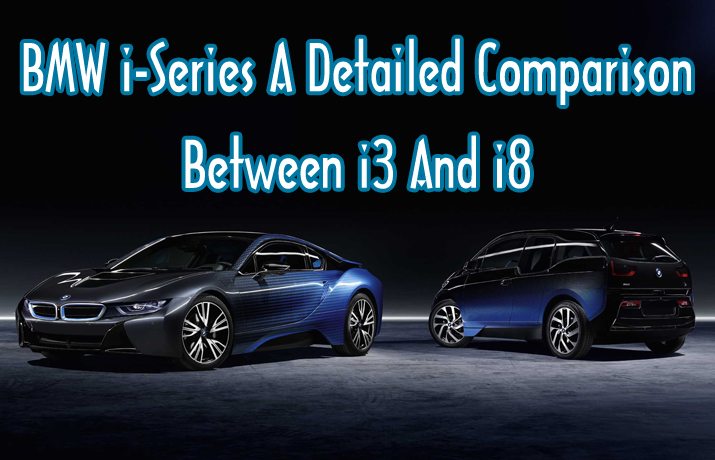
BMW has started to revolutionise the automotive world back in 2006 when they started working on its i-series. BMW tested the prototypes of its i8 in 2009 and then the world has seen the i8 in several Hollywood movies.
Now the project has been matured and BMW is fully committed to its all electric revolution as well but at the moment they are promoting their futuristic i-series by setting up the i-series as an emission-free and environmental friendly series for the world. After years and years of research and development work on these two models, BMW is now ready to put them into batch production.
BMW i3 is the smaller sibling of its larger i8 supercar version and it is a fully electric city car. It has an excellent single charge range of more than 100 miles or 160 kilometers. It is a 4 seat city car followed by its larger sibling BMW i8.
BMW says that the i8 is the more futuristic electric hybrid vehicle. However, coming back to the i3 stats, it combines the electric power with the battery charging system along with an engine powered by petrol.
So all three means of power delivery have been added to the vehicle to deliver an excellent combination of performance and emission-free mobility. Just like the BMW i8, the i3 has widely used carbon reinforced plastic CFRP materials.
These materials are used to keep the overall weight at the lowest level while not losing even a single bit of durability and power. Both vehicles apart from futuristic technologies have a raft of driver assist technologies as well and powered by efficiency features to make it a feasible vehicle to the real world.
The i-series pair of new electric vehicles are very close to happen and they will be pushed into production and both vehicles will be targeting different markets, different focus and different utilitarian view of electric mobility. Both models have been designed to maximise the benefits of emission-free mobility in both city and motorway cruising. BMW is also working on the Mini E and Active E models.
However, when it comes to finding a new car that can give you excellent fuel economy and luxury at the same time, you will have several options on hand from BMW. BMW is ahead of all that booming hybrid revolution in the world and with its i-series its demand will be significantly increased.
In the list of electric and hybrid vehicles, i-series is in real competition. Both models have a lot to offer for their drivers including intelligent drive system and active battery charging system. This head to head comparison of both vehicles will help you know more about these futuristic vehicles. It will also help you out in making your buying decision even easier when you will decide to buy a new car. Before we compare them head to head, it is better to learn about these vehicles a bit in detail, let’s start with the smaller sibling.
BMW i3 is a futuristic battery electric vehicle or shortly called BEV, with two variants, both are very identical to each other, from outside and there is a great experience required to identify the differences from outside. The i3 range based on the two trims the Rex and the i3 BEV.
The i3 BEV trim is powered by a pair of motors mounted to the rear wheels and has a range of 81 miles per electric charge. It has no engine at all. At the same time the all new BMW Rex model is more advanced and comes with the same configuration plus a 2 cylinder petrol engine under the boot floor and it extends the total range from 81 miles to 150 miles per charge. However, on all electric or battery power, the Rex has a travelling range of 72 miles. This range has been decreased because of the added weight of 2 cylinder engine.
The BMW i3 in the real world testing has delivered even more refined results and it has an incredible driving experience with only one pedal under your feet. It has a regenerative braking system and an incredibly excellent reinforced carbon fibre body to reduce overall weight but increased strength at the same time. With the help of excellent driving dynamics, the electric vehicle makes it one of the best electric vehicles in the world.
The electric hybrid supercar from the house of BMW, the i8 has the most advanced technology and driving dynamics to offer in just under million dollars. This version of i-series is also made of carbon fibre reinforced plastics and has an all-wheel drive system along with a conventional 3 cylinder engine. The i8 has an exotic looks and overall body style just like an alien craft. On the other hand, some engineers and experts say that the i8 has driving dynamics like of the Audi R8. The all new i8 uses the plug-in hybrid technology and a three cylinder turbocharged engine to make it even exotic.
This smaller engine comes with two turbo chargers to develop some stronger punch on the way to deliver even stronger performance. This twin turbo engine also comes with BMW eDrive technology in the form of an electric drive system. This 1.5 litre internal combustion engine is powered by petrol and it develops 170kw and 230 horsepower.
This engine powers the rear wheels of the i8 and electric system powers the front wheels. The i8 has an electric range of 35 miles per charge and a top speed of 75 miles per hour. If we consider it at the benchmark speed of 0 to 62 miles per hour then you will be amazed to learn that i8 will take just 4.4 seconds to reach the 62 miles per hour.
If you take these two models head to head, you will see that both models offer a lot for the drivers and become the best electric vehicles across the globe. Usually, people love to have efficiency and luxury at the same time from their newly bought vehicles and BMW i-series comes with both of these attributes.
BMW i8 and i3 offer a massive list of luxury features including comfort and innovative futuristic technologies. There will be some big differences when put them head to head. Upon comparing these vehicles head to head, you will see that the vehicles have different powertrain features and different engines and even different electric systems and also different driving range.
BMW i3 features an all-electric powertrain and it offers 114 miles driving range without any fuel. The electric system generates 170 horse power at the same time and the massive battery pack takes around three hours to the full charge.
BMW i3 has a two cylinder tiny engine to help the powertrain to get more power from it. The electric motors are coupled to the rear axles.
Other features include;
Fuel Economy MPG – City: 129 mpg
Fuel Economy MPG – Hwy: 106 mpg
Fuel Economy MPG – Combined: 118 mpg
Battery Range: mi 114 miles
Engine Type: Electric
Horsepower @ RPM: 170 @ 4800
Torque @ RPM: 184
20-Amp/Hr Maintenance-Free Battery
Gas-Pressurized Shock Absorbers
Front Anti-Roll Bar
Electric Power-Assist Speed-Sensing Steering
Strut Front Suspension w/Coil Springs
Lithium Ion Traction Battery w/7.4 kW Onboard Charger, 5 Hrs Charge Time @ 220/240V and0.75 Hr Charge Time @ 440V
Safety Features:
Electronic Stability Control (ESC)
ABS And Driveline Traction Control
Side Impact Beams
Dual Stage Driver And Passenger Seat-Mounted Side Airbags
BMW Assist eCall Emergency S.O.S
Tire Specific Low Tire Pressure Warning
Dual Stage Driver And Passenger Front Airbags
Curtain 1st And 2nd Row Airbags
Airbag Occupancy Sensor
Driver And Passenger Knee Airbag
Back-Up Camera
On the other hand, BMW i8 comes with a 1.5-liter three-cylinder engine and it has further powered by an electric motor charged by lithium-ion battery pack. This battery pack delivers the power range of 15 miles of electric driving. After the end of the battery power, the system switches over the engine power and this fuel-efficient engine delivers more than 30 miles per gallon and a top speed of 75 miles per hour. It cranks a combined power of 357 horsepower and 420 lb-ft of torque.
Engine Type: Intercooled Turbo Gas/Electric I-3
Engine: 1.5L DOHC Turbo 3-Cylinder
Displacement: 1.5 L/91
Fuel System: Petrol Direct Injection
Horsepower @ RPM: 357 @ 5800
Torque @ RPM: 420
Transmission: 6-Speed Automatic
Engine Auto Stop-Start Feature
Transmission w/Driver Selectable Mode and Sequential Shift Control w/Steering Wheel Controls
Part-Time All-Wheel Drive
TRANSMISSIONS:
Front: 2-speed automatic; 6-speed automatic with manual shifting mode
FUEL ECONOMY:
EPA city/highway driving: 28 – 29 mpg
EPA petrol and electric combined driving: 76 MPGe
Safety features;
Electronic Stability Control (ESC)
ABS And Driveline Traction Control
Side Impact Beams
Dual Stage Driver and Passenger Seat-Mounted Side Airbags
BMW Assist eCall Emergency S.O.S
Front and Rear Parking Sensors
Forward Collision and Rear Collision
Tire Specific Low Tire Pressure Warning
Dual Stage Driver and Passenger Front Airbags
Curtain 1st And 2nd Row Airbags
Airbag Occupancy Sensor
Driver and Passenger Knee Airbag
Outboard Front Lap and Shoulder Safety Belts and Pre-tensioners
Back-Up Camera
Front Camera
Left Side Camera
Right Side Camera
BMW has sold more than 30 thousand units of both i3 and i8 models since 2013 when it was launched for the first time.
