
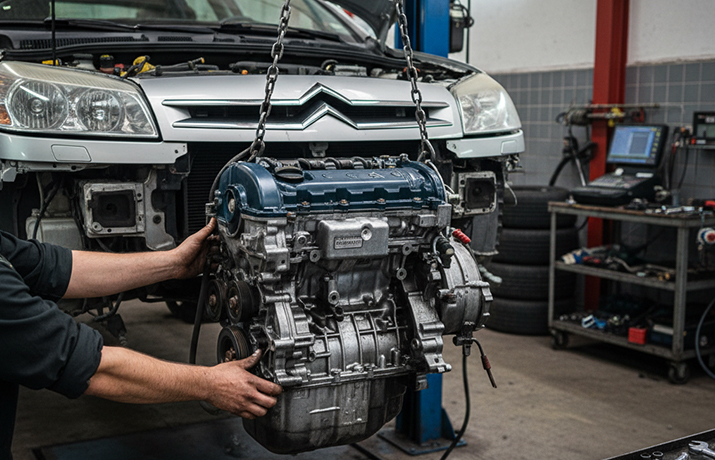
When my Citroen C5 started throwing up diagnostic trouble codes (DTCs) that pointed firmly towards a failing engine block, I knew I was staring down one of the most expensive decisions a car owner can face. Main dealers quoted me figures that made my eyes water — we’re talking thousands of pounds before they’d even looked at ancillary parts like the water pump or timing belt. A colleague had recently used a mobile mechanic for a smaller job and raved about the savings, so I started exploring whether engine supply and fitting could realistically be handled outside of a traditional garage setup. The appeal was obvious: no workshop overheads, lower labour rates per hour, and the mechanic coming directly to my driveway. But I’ll be honest — I was nervous. An engine isn’t a set of brake pads. It’s the heart of the car.
What tipped me towards going ahead was the mechanic’s transparency. He walked me through the entire process before a single bolt was touched — explaining fluid flush and refill procedures, discussing whether my ancillary components were worth reusing, and showing me the fixed-price quotes he’d prepared in writing. He also had his own engine hoist and specialised tools, which I hadn’t expected. I’d assumed mobile work meant compromised equipment. He disabused me of that idea quickly. His approach felt informed and methodical rather than rushed, and when he mentioned he regularly sourced from reputable suppliers offering Citroen C5 supplied and fitted packages, I felt slightly more confident that this wasn’t going to be a backstreet bodge job.
This is where I spent the most time before anything physical happened to my car. Searching for a reconditioned Citroen C5 engine online is a minefield if you don’t know what to distinguish a quality supplier from a dodgy listing. I explored several routes — online engine marketplaces, salvage yards, and specialist suppliers advertising themselves as a replacement engine supplier near me. The sheer volume of results when you search terms like engine for sale or used engine for sale near me is overwhelming, and not everything that appears at the top of a search is worthy of your money. I learned to filter quickly: does the supplier offer a buyer protection guarantee? Do they have verified customer testimonials and Trustpilot ratings? Is VAT inclusive pricing clearly stated, or are there hidden charges lurking in the small print?
What I eventually found — after considerable research — was that the most dependable suppliers of reconditioned engines UK tend to be transparent about the donor vehicle condition, provide verified mileage documentation, and carry out HPI clearance checks on the units they sell. These aren’t small details; they’re the difference between an engine that lasts another 80,000 miles and one that gives up six months later. The supplier my mechanic recommended offered a full surcharge exchange policy on the old core unit, meaning I got a partial credit for handing back my worn engine. That reduced the overall cost meaningfully and is something most people don’t realise they can negotiate. If you’re searching for the best place to buy Citroen engines, look for suppliers who treat this kind of after-sales structure as standard, not as an optional extra.
One of the most useful conversations I had during this entire process was getting the mechanic to properly break down the terminology, because when you’re browsing listings for a rebuilt Citroen C5 or a remanufactured Citroen C5 engine, these words get used interchangeably by sellers who perhaps shouldn’t. In reality, they describe meaningfully different processes. A recon engine — short for reconditioned — has typically had worn components replaced and surfaces machined back to serviceable tolerances and clearances, but the extent of that work varies enormously between suppliers. A rebuilt engine usually means it’s been stripped, inspected, and reassembled with replacement parts where necessary. A remanufactured unit, however, is the most thorough of the three: it’s restored to OEM (Original Equipment Manufacturer) specifications, often involving crankshaft grinding, cylinder head resurfacing, engine block honing, and the fitting of oversized pistons and rings where the block has worn beyond standard limits.
At the other end of the spectrum sits the second-hand Citroen C5 engine — sometimes called a used Citroen C5 or 2nd hand engine — which is essentially a pulled unit from a salvage vehicle with no machining work carried out. These are cheaper, sometimes significantly so, and can be perfectly serviceable if the donor vehicle had low mileage and solid service history records. However, they come with greater uncertainty. You’re buying the engine largely as-is, which means compression testing is essential before fitment, and you’re relying heavily on the honesty of the supplier about internal combustion assembly condition. My mechanic advised me that for a car I intended to keep long-term, the extra investment in a properly reconditioned or remanufactured unit was worth it — and looking back, I agree entirely.
On the day of the job, the mechanic arrived early with a full kit: engine hoist, stands, drain trays, torque wrenches, and a laptop for ECU re-programming — something I genuinely hadn’t anticipated being necessary. When you swap an engine, particularly on a modern Citroen C5 with its layered electronics, the engine management system often needs to be told about the new unit. Without ECU re-programming, you can end up with persistent fault codes or, in some cases, a car that won’t start at all. This is a nuance that separates a fully certified technician from someone who’s simply mechanically competent — knowing what the car’s brain needs, not just what the engine needs.
The process took most of the day. There were no major surprises, but there was one moment of concern: when the replacement Citroen C5 engine arrived, my mechanic insisted on carrying out a compression test before fitment — a step I hadn’t thought to ask about but which turned out to be essential good practice. One cylinder showed slightly lower compression than the others, which he flagged to the supplier immediately. After a brief back-and-forth, the supplier arranged a swap without argument, which told me everything I needed to know about their buyer protection guarantee. The replacement unit passed all checks. Once fitted, the car started cleanly, pulled smoothly, and the DTCs cleared without issue. I’d have been far less fortunate had I opted for a used motor engine from an unverified listing with no recourse if something was wrong.
Before committing to anything, I did extensive price research because I wanted to understand whether what I was being quoted reflected fair reconditioned engine prices or whether I was being taken for a ride. The cost of Citroen C5 reconditioned engine for a varies depending on the engine code, displacement, and whether you’re looking at petrol or diesel — the C5 was sold with several variants across its production run, and low-mileage petrol/diesel units command different price points. I cross-referenced multiple suppliers offering a reconditioned engines price list UK and found that for a professionally reconditioned diesel unit to British Engineering Standards (BS EN), prices ranged from around £800 to £1,600 supplied only, with labour on top.
The engine price you see advertised is rarely the complete figure, and this is where buyers often get caught out. Once you factor in labour rates per hour for removal and refitting, fluid flush and refill costs, any new ancillary parts, and VAT inclusive pricing, the total can climb considerably. My all-in cost for a quality reconditioned engine supplied and fitted came to just over £1,900 — which, when I compared it against a dealer’s estimate for a new unit with labour, represented a saving of roughly £1,400. The reconditioned engines price list from the supplier I used was itemised clearly, which made it easy to see exactly what I was paying for. If a supplier can’t give you a breakdown of machining costs and parts separately, that’s a warning sign worth taking seriously.
Looking back with a clear head, yes — I would recommend this route, but with important caveats that I think most articles about engine replacement UK gloss over entirely. The success of my experience rested on three pillars: a genuinely skilled and well-equipped mobile mechanic, a reputable supplier with transparent policies, and my own willingness to ask questions and verify information rather than simply trusting the cheapest quote.
If any one of those elements had been weaker, the outcome could have been very different. The UK market for refurbished engines near me searches is full of capable professionals and reliable suppliers — but it’s also home to operators who will sell you a used Citroen C5 engine with inflated mileage claims and no meaningful warranty claim procedure in place.
