
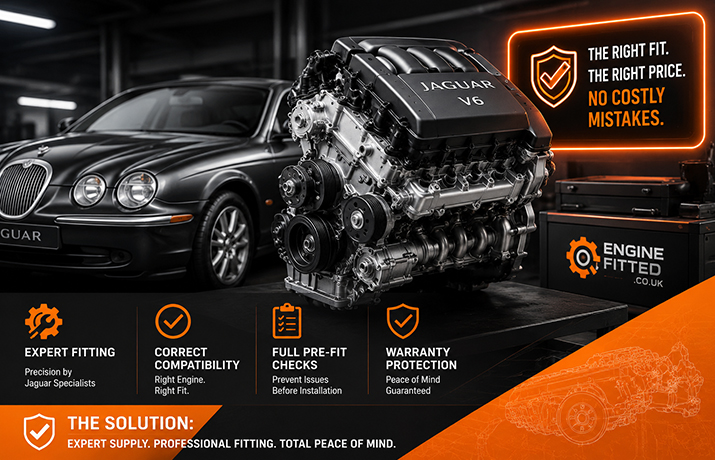
If you are considering a reconditioned Jaguar S-Type Engine Supply and Fitting package, the biggest risk is not the engine itself. The biggest risk is the gap between the company supplying the engine and the garage fitting it.
When supply and installation are separated, buyers often become trapped between two parties if a problem develops. The supplier may blame the fitter. The fitter may blame the supplier. Meanwhile, the vehicle owner faces additional diagnostic charges, removal costs, return shipping fees and potentially a second labour bill.
A Remanufactured Jaguar S-Type Engine supplied and installed under a single contract creates one point of accountability, one warranty pathway and one responsible party. That structure alone can prevent hundreds or even thousands of pounds in duplicated costs.
| Scenario | Estimated Cost |
| Initial engine fitting labour | £700–£900 |
| Engine removal after failure | £500–£800 |
| Second diagnostic inspection | £100–£250 |
| Return shipping of failed engine | £150–£400 |
| Re-fitting replacement engine | £700–£900 |
| Worst-case double-failure scenario | £2,150–£4,050+ |
When supply and fitting are split between different businesses, responsibility becomes fragmented. The burden of proving fault often shifts towards the vehicle owner.
Under the UK Consumer Rights Act 2015, buyers have protections regarding satisfactory quality and fitness for purpose. However, when separate contracts exist for supply and installation, establishing liability can become significantly more complex.
A typical dispute sequence looks like this:
At every stage, additional costs accumulate.
Under a combined supply-and-fit contract, the customer deals with one provider responsible for delivering a working installation.
Manyfitting invoices contain clauses specifically excluding liability for defects found in customer-supplied engines. Those clauses are designed to protect the garage before any dispute even begins.
Most buyers spend weeks comparing the replacement engine price, researching the cost of reconditioned Jaguar engine options and searching for a reliable used engine for sale. Yet the largest financial risk often appears after the engine arrives.
This is where the Double-Labour Hostage Game begins.
The split supply chain places the buyer in a hostage position before they even realise it exists. One company supplies the engine. Another company installs it. If the engine develops a fault six months later, neither party automatically accepts responsibility.
The supplier may argue the engine was fitted incorrectly.
The garage may argue the engine was defective from the outset.
The buyer sits in the middle paying for diagnostics while both parties defend themselves.
In many workshop disputes involving independently sourced engines, the first casualty is accountability. The second casualty is usually the buyer’s wallet.
The fitting trap that costs buyers £800 twice is not theoretical. It is a structural consequence of separating supply from installation.
Fortunately, there is one structural escape.
One bill. One warranty. Zero blame-shifting.
Buying separately can expose you to duplicated labour costs. Unified supply and fitting dramatically reduces the possibility of repeated labour charges.
| Scenario | Supply Only | Supply and Fit | Who Pays? |
| Engine failure after 3 months | ✖ | ✔ | Usually buyer under supply-only disputes |
| Fitting error discovered | ✖ | ✔ | Depends on fitter under split arrangement |
| Wrong engine supplied | ✖ | ✔ | Often disputed between parties |
| Return shipping required | ✖ | ✔ | Frequently buyer |
| Second diagnosis needed | ✖ | ✔ | Frequently buyer |
| Re-fit labour required | ✖ | ✔ | Frequently buyer |
The practical difference becomes obvious after a failure.

With supply only, the buyer may fund removal, inspection and reinstallation before the supplier even decides whether the warranty claim is valid.
With supply and fit, the provider generally manages the entire process under one contractual relationship.
A can correctly install a customer-supplied engine and still charge full labour again if that engine later proves defective.
Any supplier offering a Remanufactured Jaguar S-Type Engine should be able to demonstrate competence, traceability and accountability.
Look for evidence of recognised industry standards, membership affiliations and documented warranty procedures.
Relevant industry associations may include:
Before paying anything, ask these six questions:
Red flags include:
The Consumer Rights Act 2015 requires goods and services to be satisfactory, fit for purpose and supplied with reasonable care and skill. Combined contracts often provide a clearer path for enforcing those rights.
Many online brokers never physically inspect the engine they advertise for sale.
The Jaguar S-Type 276DT diesel engine requires more than simply bolting in a replacement unit. Proper commissioning procedures directly influence reliability.
Critical post-installation procedures may include:
A genuine professional fitting process also includes:
Budget installations often skip these stages because they consume workshop time.
Some engine failures blamed on suppliers are actually caused by inadequate oil priming during installation.
A properly fitted replacement engine should not negatively affect MOT compliance. The replacement must match applicable emissions requirements and remain compatible with the vehicle’s original systems.
After installation, owners should verify:
If the replacement engine differs significantly from the original specification, DVLA notification obligations may arise.
A professionally installed remanufactured engine often performs better during emissions testing than a severely worn original unit.
Unresolved injector coding or DPF adaptation issues can create MOT emissions failures even when the replacement engine itself is perfectly healthy.
A unified warranty should protect both the engine and the installation. Anything less can leave liability gaps.
Read every warranty document carefully and verify:
Pay particular attention to wording involving:
A genuine unified warranty reduces opportunities for blame-shifting because the same organisation supplied and installed the engine.
What most independent garages won’t tell you is… many warranty disputes originate from exclusions buried in the small print rather than from the engine itself.
A remanufactured engine is rebuilt to strict engineering tolerances using inspected and renewed components. It is designed to restore performance, reliability and service life closer to original factory standards.
Yes. A combined package creates one accountable supplier for both the engine and the installation. This significantly reduces blame-shifting risks and duplicated labour charges.
Prices vary according to specification, condition and warranty level. Supply-and-fit packages generally cost more initially but may reduce long-term liability exposure.
Yes, injector coding verification is normally recommended. Incorrect coding can affect fuel delivery, emissions performance and overall engine operation.
Oil priming helps establish lubrication before initial start-up. Failure to prime correctly can increase wear risk for bearings and turbocharger components.
Yes. Excessive back-pressure from a restricted DPF can place additional stress on the engine and turbocharger system. Proper diagnostics should be completed before handover.
The answer depends entirely on the contract structure. Unified supply-and-fit agreements generally provide clearer accountability than separate supply and installation arrangements.
Usually, yes. However, a lower purchase price does not automatically mean a lower ownership cost because reliability, warranty protection and future repair risks vary significantly.
The gap between supply and fit is where buyers get hurt. The Double-Labour Hostage Game exists because separate suppliers and installers can transfer responsibility between each other while the vehicle owner absorbs the cost. If you’re comparing a Jaguar S-Type engine Supply and fitting package against supply-only options, focus on accountability before price. One supplier, one installer, one warranty and one responsible party remain the simplest way to avoid becoming the person who pays for the same labour twice.
