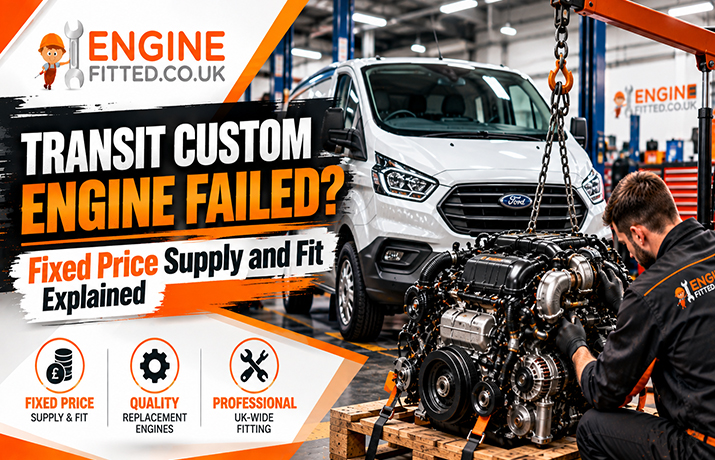
A supplied and fitted Transit Custom engine runs £2,400–£4,200 depending on the route. Weigh that against a week of lost work and the decision usually makes itself. A van earning £250 a day costs £1,250 for every five days off the road.
Route
Supplied and fitted
Lead time
Cover
Suits
Used EcoBlue engine
£2,400–£3,400
2–5 days
30–90 days
Older vans, urgent jobs
Reconditioned engine
£3,400–£4,200
1–3 weeks
12 months written
Vans you keep
Short engine
£2,900–£3,800
3–7 days
Varies
Sound ancillaries
Rebuild your own
£3,000–£4,000
2–4 weeks
Varies
Low-mileage vans
Which Transit Custom engine code do you need?
Years
Engine
Code
Note
2016–2019
2.0 EcoBlue
YLF6 / YMF6
Widely available
2018–2020
2.0 EcoBlue
YMR6 / YNR6
More electronics to code
2019 onward
2.0 EcoBlue
later revisions
Confirm against REG
Two vans of the same year can carry different codes. Give the registration when you ask for a quote and check the code on the engine itself before collection.
What a fixed-price supply and fit should include
The engine matches your REG and code.
Removal and refitting labour.
New timing belt, tensioner and water pump.
Oil, oil filter, coolant and gaskets.
Injector and turbo check and transfer.
Coding, adaptation and a road test.
Disposal or core exchange of the old engine.
How fast can a working van be back on the road?
Two to five days with a used engine already in stock, provided the workshop slot is booked before the van arrives. Vans booked the same day they are recovered are almost always back sooner than vans parked waiting for a decision.
Ring with the registration and code ready.
Approve the consumables list on the first call.
Confirm the collection date in writing.
Arrange a hire van only if the downtime exceeds three days.
Ask for the engine number on the invoice at collection.
What normally kills a Transit Custom engine?
Injector seal failure contaminating the oil.
Timing belt or oil pump drive failure.
Turbo failure after oil starvation.
Overheating that warps the head.
DPF and EGR blockage on short-run vans.
Catching any of those early saves an engine. A whistle, a rattle or rising oil consumption is your warning window.
What should you do the day the van fails?
Stop the engine and stop trying to start it.
Photograph the dash and warning messages.
Write down the symptoms while they are fresh.
Recover the van to a specialist, not to a general garage.
Start the quote process immediately.
Frequently asked questions
How much does a Transit Custom engine cost fitted?
£2,400–£3,400 for a used engine and £3,400–£4,200 for a reconditioned one, supplied and fitted at independent rates.
Is a used EcoBlue engine safe to fit?
With a compression test, a mileage record and a written warranty, it is a reasonable risk on an older van.
Can I keep working while the van is repaired?
Only with a hire van. Compare hire costs against the speed of a used engine versus the warranty value of a reconditioned one.
Does the price include the timing belt?
On a proper fixed-price job it should. Get it listed in writing along with the water pump.
Is a reconditioned engine worth it on a 2017 van?
Yes if you intend to keep it another two or three years; the 12-month written warranty is the deciding factor.
How do you confirm a Transit Custom engine code?
Read the code from the REG and the build sticker, then check it against the Ford parts catalogue. The EcoBlue family uses similar-looking units with different sensors and software.
REG decoded and code confirmed in writing.
Donor engine documentation checked.
Turbo and injector specification compared.
Ancillary fitment confirmed.
Deposit only after written confirmation.
What does the fitting day look like?
Transit Custom engines come out from the front with the front panel and cooling pack moved forward. It is a two-day job for a competent workshop when the replacement Ford Transit engine is ready.
Vehicle drained and front-end stripped.
Engine and gearbox separated.
Replacement prepared with new belt, pump and seals.
Refit, refill, code and road test.
Fault codes read and cleared.
Why do EcoBlue engines fail early?
Injector seal failure contaminating the oil and damaging bearings.
Wet belt or oil pump drive failure on affected builds.
Turbo failure after oil starvation.
DPF and EGR blockage on short-run delivery vans.
Overheating from a failed thermostat or blocked radiator.
What habits keep a replacement EcoBlue engine healthy?
Oil and filter every 6,000 miles on town work.
The correct low-SAPS oil for the DPF.
Weekly longer runs to allow regeneration.
Coolant level checked monthly.
Any new noise investigated immediately.
What should the warranty on a supplied and fitted van engine include?
Internal engine failure, plus labour to remove and refit, plus the parts replaced at the same time. Ask what voids it, and get the answer in writing before you pay.
What should a van owner do in the first week after an engine change?
Keep the first 500 miles light and check the fluids daily. Vans get loaded straight away, and that is exactly what shortens the life of a new engine.
No heavy loads for the first 500 miles.
Oil and coolant checked daily for the first week.
Oil and filter changed at 500 miles.
Codes re-read at 500 miles.
Any warning light reported immediately.
Is a rebuild worth considering for an EcoBlue?
Rarely. The EcoBlue is a complex unit and rebuild costs approach replacement prices, so a reconditioned engine with a written warranty usually makes better financial sense.
Rebuild: £3,000–£4,000, two to four weeks.
Reconditioned: £3,400–£4,200, one to three weeks, warranty included.
Used: £2,400–£3,400, under a week.
Compare downtime costs on every route.
Always get the warranty in writing.
How do you verify the installation was done properly?
Old parts returned, codes printed before and after, a documented road test, and a warranty certificate on collection. If any of those is missing, push back before you pay the balance.
Can a Transit Custom be worked on while you wait?
Rarely. These are two-day jobs at best, and rushing them causes the problems owners complain about later. Book the slot before the van is recovered to keep downtime to a minimum.
Book the workshop slot first.
Confirm the engine is on site before the van arrives.
Allow two full working days minimum.
Ask for a collection time, not a collection day.
Keep a hire van plan for jobs over three days.
What does the total Transit Custom engine job look like?
Item
Typical cost
Used EcoBlue engine, supplied and fitted
£2,400–£3,400
Reconditioned unit, supplied and fitted
£3,400–£4,200
Turbo, if required
£700–£1,200
Injectors, if required
£600–£1,100
Hire van per week
£300–£600
Post-fit oil change
£90–£140
Should I fix a van with 180,000 miles on it?
If the body and gearbox are sound and the van is worth keeping, yes. If the van is already showing rust, suspension wear and a tired gearbox, a replacement engine may be throwing good money after bad.
What is the biggest mistake van buyers make?
Judging a van on the engine price alone. Two quotes that differ by £300 can differ by a week in lead time, and a week off the road costs more than the difference.
What is the right engine choice for a busy Transit Custom?
Speed matters most when the van is working, but a 12-month warranty matters when it is not. Most owners running 25,000 miles a year are better served by a reconditioned unit, even at a week’s delay.
Under 15,000 miles a year — a tested used Ford Transit engine is usually enough.
Over 25,000 miles a year — reconditioned with a written warranty.
Leased or financed van — check the agreement first.
Van with other faults — repair the engine only if the rest is sound.
Always confirm the code before ordering.
How do you choose between speed and warranty on a working van?
Work out what a week off the road costs you. If it is more than the price difference between used and reconditioned, take the used engine today and put the warranty question aside.